
‘Insurers will never let you down.’ In this joint interview, we speak to the two co-owners of Ship Insurance International, a maritime broker where a personal approach is paramount. Based in the north of the Netherlands, Marijke van der Rest and Monique Reinek help their clients find the right marine insurance.
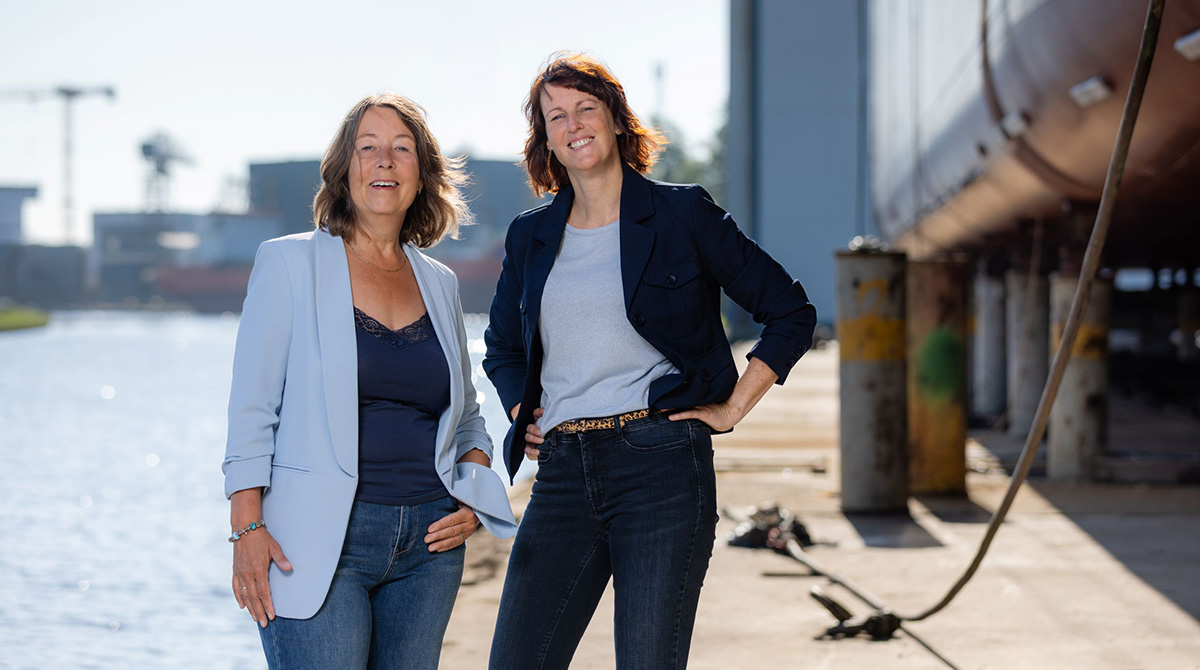
Although the two have been working together in their firm for quite some time now, they actually come from very different backgrounds. Marijke van der Rest studied communications and information sciences in Groningen and, after graduating, went to work at her father’s estate agency. This where she first crossed paths with Monique Reinek, who had stumbled into the insurance industry by chance much earlier and has now been happily working in it for decades. The collaboration went so well that they decided to set up their own company together.
Your father was also a broker. Was it only natural that you would end up in the same profession?
Marijke: ‘No, not really. I was at university and looking for a job in my chosen field. Then my father said, “Why don’t you just come and work for me? I agreed and ended up staying. It’s lovely to see that more and more women are getting actively involved in the industry. This has a positive effect on the profession and on how it is perceived. Insurance has always been a conservative stronghold, but you can see that things are changing. I recently saw a photo of my father and his team from the early 1980s. All men in brown suits!’
Monique: ‘I only realised how wonderful the maritime sector was when I started working at Marine Insurance with Marijke’s father. That was back in 2008. I experienced there just how much passion there is in this industry. I actually started out in the typing pool back in the days of the brown suits and then went on to become an underwriter at an industrial fire insurer.’
How did that lead to you setting up your own company?
Marijke: ‘My father sold his business to a large broker in 2012. That was OK initially, but after a while we realised that a large company thinks differently from a specialist broker. My knowledge and experience were dismissed as less relevant and our clients started to become dissatisfied; they missed the familiar speed and commitment. Other priorities took precedence; everything had to go through the central system. That didn’t really work for us. “The computer says no.” Soon little irritations like that started to mount up. Our sector requires a bespoke approach and that was no longer possible.’
‘At one point, Monique and I thought, “What are we going to do now?” That’s when we decided to set up our own business. It was nerve-wracking. Would we be able to build up a full portfolio again? Fortunately, many clients found their way to us once we got started.’
How does Ship Insurance International stand out from its competitors?
Monique: ‘We realised how important it is to make our own decisions. That’s why we keep banks and shareholders at arm’s length because whoever pays the bills calls the shots. Although we do want to grow we’re not aiming at becoming a huge firm. Our small scale is our strength. It enables us to keep delivering a high standard of service. Personal involvement is very important to our clients.’
Marijke: ‘All the more so because there aren’t many smaller brokers left! Everyone is being bought up; there’s a lot of consolidation going on. With us, there are no layers of management to wade through: Monique and I just look at each other and make a decision.’
Do you ever go out on the water yourself?
Marijke: ‘I do sloop rowing! We row as a team in a rescue sloop, through a club. We compete in races all over the Netherlands, such as the Harlingen-Terschelling race. Our team has come second and third in the Netherlands. The community around it is great; Wagenborg and Boomsma also sponsor a sloop, for example; you see shipyard logos on the sloops – it’s a very maritime thing. Our ambition is to take part in the Great River Race in London again.’
The maritime world is under considerable pressure from geopolitical developments. How do you deal with this? Is this even a thing for your clients?
Marijke: ‘We’re lurching from one crisis to the next – from Covid to Ukraine to Iran, and before that there was an economic crisis too. Amidst all this it’s good to see that the shipping industry always adapts. This is the case again now. Although we do not have any ships sailing through the Strait of Hormuz, as an industry we are, of course, certainly feeling the impact of higher fuel prices. What we do ourselves is keep a close eye on everything, so that we can respond accordingly. The prevailing view among our clients is that it is challenging, but that we will be able to cope with this again. No matter how complicated it may be.’
‘Insurers will never let you down.’ We have war insurance policies, which are relevant in high-risk areas such as the Persian Gulf, West Africa and Venezuela. This allows you to continue trading in troubled regions. And those policies remain in force. When things got tense in these regions, we received many calls from newspapers and news programmes such as NRC and Nieuwsuur, asking whether insurers were going to pull out. They are not going to. At most, some insurers may review their premium. Even in the face of massive disasters, the sector remains resilient. When the Piper Alpha oil production platform in the North Sea caught fire in 1988, it caused so much damage to the London market that a number of insurers went under. The sector nevertheless managed to absorb the losses. This shows just how resilient the insurance industry is. And it has to be, because ninety per cent of world trade is carried by sea.’
What kind of trends do you see in the shipping industry?
Monique: ‘We’re seeing a push for innovation and sustainability at our shipyards. Ships have started to use different types of fuel, such as LNG and methanol, or hybrid engines. You’re reading more and more about ships fitted with VentoFoil sails (from Econowind), to use the wind as an auxiliary propulsion force. We recently attended a JH-143 seminar organised by Halyard Risk in London, where Vera Terlouw from Allseas gave a presentation on “Propelling Offshore Innovation through Nuclear Energy”. Allseas is working with TU Delft to develop nuclear energy as a fuel for offshore vessels. This is an SMR, or Small Modular Reactor and it could well be the future.’
What does this transition require of shipping companies (and insurers)?
Monique: ‘Developing all these new propulsion methods and new ships comes at a cost. Our shipyards and shipowners need to have their new sustainable ships insured, so we’re discussing this with them. How does it work from an insurance perspective, and how do you deal with it? For example, there are sometimes concerns about the fire safety of batteries. It’s up to us to ensure that the whole thing is insurable. Insurers collect a great deal of data on these kinds of issues so that they can make a sound risk assessment of these new propulsion methods. We then discuss this with our clients and can reassure them with a good insurance policy.’
‘Generally speaking, a healthy, stable shipping company is able to invest in sustainable vessels. However, this does require cooperation across the entire sector; the banks must also play their part.’
What is your relationship with NNPC Marine Insurance like?
Marijke: ‘We have a great working relationship. They act quickly, when it comes to claims as well as when it comes to underwriting, and really put the customer first. We also share knowledge. For example, we might discuss a hull damage claim involving a legal issue. Ultimately, we know more together than we do alone.’
Monique: ‘NNPC offers a high standard of service and they’re willing to share thoughts and ideas with us. We’re close to each other, here in the north, so it’s easy to bounce ideas off one another.’
Is there anything else you’d like to add?
Monique: ‘Working in insurance is wonderful, particularly in our dynamic maritime sector. I hope that many young people will choose this profession to counter the ageing workforce. There are great opportunities for a career right now. Insurance is unfairly seen as dull, but it’s actually incredibly interesting: you’re working at the intersection of technology, geopolitics and people.’
Want to know more?
If you’d like to find out more about Ship Insurance International, please visit their website. For all your marine insurance needs, NNPC Marine Insurance is the right place for you. Take a look at our products and services here.